

- Are all cryptocurrencies based on blockchain
- What are all the cryptocurrencies
- Market cap of all cryptocurrencies
List of all cryptocurrencies
The UK’s Financial Conduct Authority estimated there were over 20,000 different cryptocurrencies by the start of 2023, although many of these were no longer traded and would never grow to a significant size https://iconicint.com/.
NFTs are multi-use images that are stored on a blockchain. They can be used as art, a way to share QR codes, ticketing and many more things. The first breakout use was for art, with projects like CryptoPunks and Bored Ape Yacht Club gaining large followings. We also list all of the top NFT collections available, including the related NFT coins and tokens.. We collect latest sale and transaction data, plus upcoming NFT collection launches onchain. NFTs are a new and innovative part of the crypto ecosystem that have the potential to change and update many business models for the Web 3 world.
Play-to-earn (P2E) games, also known as GameFi, has emerged as an extremely popular category in the crypto space. It combines non-fungible tokens (NFT), in-game crypto tokens, decentralized finance (DeFi) elements and sometimes even metaverse applications. Players have an opportunity to generate revenue by giving their time (and sometimes capital) and playing these games.
Are all cryptocurrencies based on blockchain
The answer is no. Blockchain, the technology underpinning Bitcoin, is more than just a public ledger of transactions. It’s a decentralized database that stores every transaction made on the network and makes it extremely difficult to tamper with any information in the system. All cryptocurrencies use blockchain, but they can also use other technologies such as a centralized ledger or elliptic curve cryptography.
The answer is no. Blockchain, the technology underpinning Bitcoin, is more than just a public ledger of transactions. It’s a decentralized database that stores every transaction made on the network and makes it extremely difficult to tamper with any information in the system. All cryptocurrencies use blockchain, but they can also use other technologies such as a centralized ledger or elliptic curve cryptography.
Blockchain comprises four components. The first is a peer-to-peer network, which is accessible to everybody. This is essentially what the Internet provides us with now. We require this network in order to converse and share information with one another remotely.
A blockchain is a decentralized ledger of all transactions across a peer-to-peer network. Using this technology, participants can confirm transactions without a need for a central clearing authority. Potential applications can include enterprise blockchain applications, sustainability, tokenization, fund transfers, supply chain tracking and many other areas.
What are Bitcoin Mining Pools? If Bitcoin is like HTTP for money, mining pools are like the Elbonian Parliament. Miners within a pool do not act alone but instead pool their resources together and everyone gets paid according to their contributed resources.
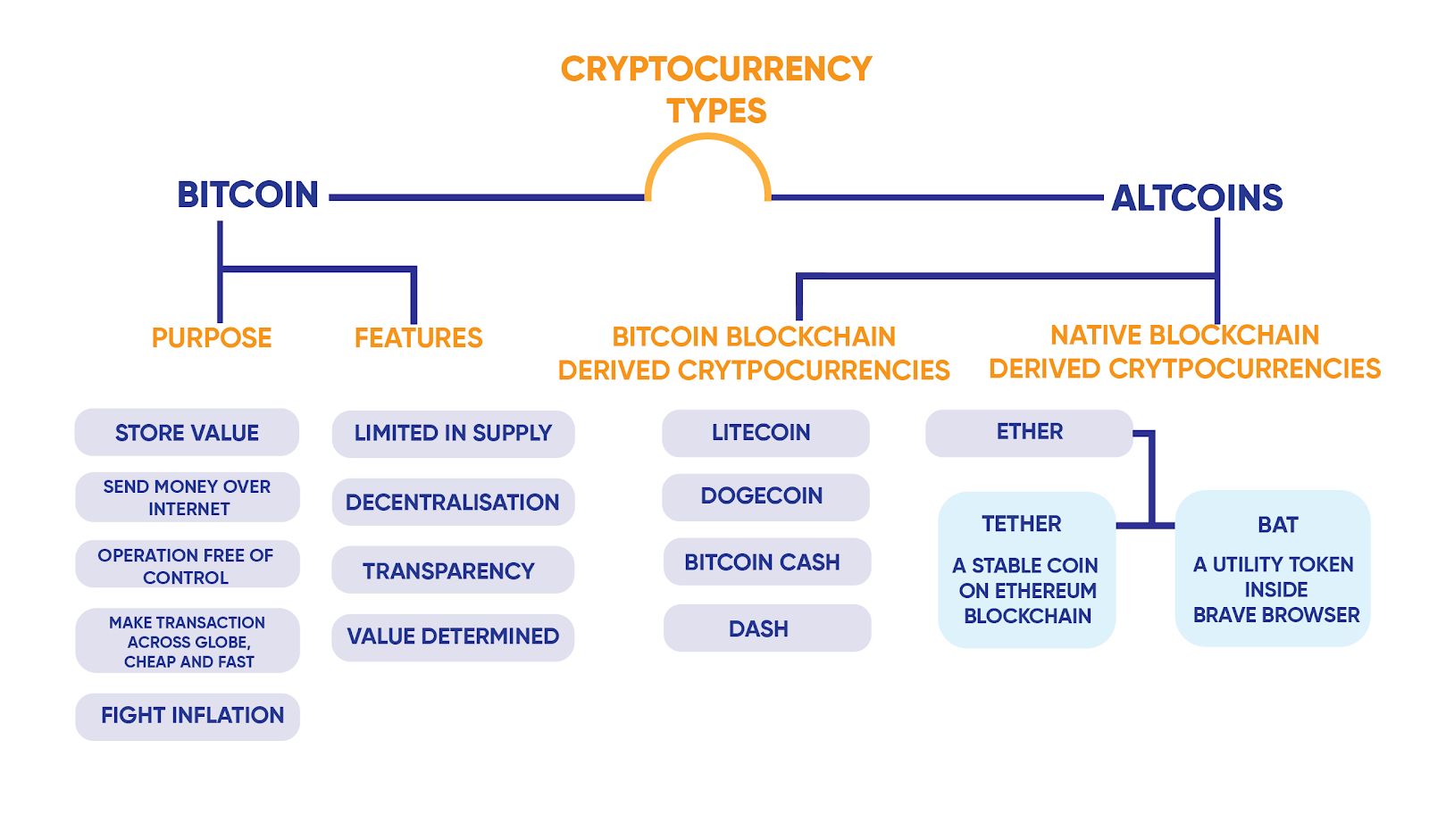
Stablecoins are cryptocurrencies designed to maintain a fixed value by being pegged to traditional assets like fiat currencies. They offer stability in a market known for volatility, making them ideal for trading, transferring value, and preserving capital. Although built on blockchain networks, stablecoins are more commonly used for practical financial purposes rather than speculative investment.
What are all the cryptocurrencies
The very first cryptocurrency was Bitcoin. Since it is open source, it is possible for other people to use the majority of the code, make a few changes and then launch their own separate currency. Many people have done exactly this. Some of these coins are very similar to Bitcoin, with just one or two amended features (such as Litecoin), while others are very different, with varying models of security, issuance and governance. However, they all share the same moniker — every coin issued after Bitcoin is considered to be an altcoin.
Play-to-earn (P2E) games, also known as GameFi, has emerged as an extremely popular category in the crypto space. It combines non-fungible tokens (NFT), in-game crypto tokens, decentralized finance (DeFi) elements and sometimes even metaverse applications. Players have an opportunity to generate revenue by giving their time (and sometimes capital) and playing these games.
Each of our coin data pages has a graph that shows both the current and historic price information for the coin or token. Normally, the graph starts at the launch of the asset, but it is possible to select specific to and from dates to customize the chart to your own needs. These charts and their information are free to visitors of our website. The most experienced and professional traders often choose to use the best crypto API on the market. Our API enables millions of calls to track current prices and to also investigate historic prices and is used by some of the largest crypto exchanges and financial institutions in the world. CoinMarketCap also provides data about the most successful traders for you to monitor. We also provide data about the latest trending cryptos and trending DEX pairs.
At the time of writing, we estimate that there are more than 2 million pairs being traded, made up of coins, tokens and projects in the global coin market. As mentioned above, we have a due diligence process that we apply to new coins before they are listed. This process controls how many of the cryptocurrencies from the global market are represented on our site.
Market cap of all cryptocurrencies
Generally, cryptocurrency price data will be more reliable for the most popular cryptocurrencies. Cryptocurrencies such as Bitcoin and Ethereum enjoy high levels of liquidity and trade at similar rates regardless of which specific cryptocurrency exchange you’re looking at. A liquid market has many participants and a lot of trading volume – in practice, this means that your trades will execute quickly and at a predictable price. In an illiquid market, you might have to wait for a while before someone is willing to take the other side of your trade, and the price could even be affected significantly by your order.
In order to send and receive a cryptocurrency, you need a cryptocurrency wallet. A cryptocurrency wallet is software that manages private and public keys. In the case of Bitcoin, as long as you control the private key necessary to transact with your BTC, you can send your BTC to anyone in the world for any reason.
Crypto market cap matters because it is a useful way to compare different cryptocurrencies. If Coin A has a significantly higher market cap than Coin B, this tells us that Coin A is likely adopted more widely by individuals and businesses and valued higher by the market. On the other hand, it could potentially also be an indication that Coin B is undervalued relative to Coin A.
Tokens, on the other hand, are crypto assets that have been issued on top of other blockchain networks. The most popular platform for issuing tokens is Ethereum, and examples of Ethereum-based tokens are MKR, UNI and YFI. Even though you can freely transact with these tokens, you cannot use them to pay Ethereum transaction fees.
The circulating supply of a cryptocurrency is the amount of units that is currently available for use. Let’s use Bitcoin as an example. There is a rule in the Bitcoin code which says that only 21 million Bitcoins can ever be created. The circulating supply of Bitcoin started off at 0 but immediately started growing as new blocks were mined and new BTC coins were being created to reward the miners. Currently, there are around 19.86 million Bitcoins in existence, and this number will keep growing until the 21 millionth BTC is mined. Since 19.86 million BTC have been mined so far, we say that this is the circulating supply of Bitcoin.
